
St. George Past-Resident Sources
The era table keeps legal title, household clues, and physical history apart. Previous residents can appear in one source and not another because each source has a different purpose.
| Source | Years it covers | Where held | What it shows |
|---|---|---|---|
| Recorder Old Abstract | 1854–1992 | Washington County GIS map inventory | Historical title abstracts |
| Recorded deeds and plats | Online cutoff not located | Washington County Recorder | Parties, instruments, legal descriptions |
| WCHS telephone books | 1941, 1954, 1958, 1961, 1972 leads | Historical Society | Dated subscribers, numbers, addresses |
| Utah Tech WASH-051 | 1971–2022, with gaps | Special Collections | Regional phone-book entries |
| Archives birth series | 1898–1905 | Utah State Archives | Register entries and provenance |
| Census / newspapers | Release and source rules | National Archives / digital archive | Household, event, and address context |
The table begins with the property record because an address history needs a stable parcel before names from older sources can be compared.
St. George Previous Resident Parcel
Enter the address in USPS, then compare Washington County GIS and St. George PowerMobile. Save the current account number, parcel number, subdivision name, city-limit layer, and any situs or mailing distinction. A parcel is the mapped land unit. A situs address is where it lies; a mailing address is where correspondence goes. An owner’s mailing address may be outside St. George.
- Normalize the current address, including unit, city, state, ZIP, and ZIP+4.
- Find the parcel by address, account number, or parcel ID in county GIS.
- Compare the city map and note subdivision or city-limit context.
- Use the parcel, not only the street string, in the Recorder search.
- Keep the modern result as a starting hinge, not a conclusion about occupancy.
Unit numbers, corner lots, parcel splits, alleys, and old street names can break a simple address search. Record the exact historic wording before substituting a current one.
St. George Previous Resident Deeds
In the Recorder index, search the current owner as grantee. Locate the latest deed or instrument, its recording date, document number, book and page when shown, and its legal description. The prior deed often names the earlier grantor. Search that party as grantor, then move back through each grantor and grantee pair. Grantor means the person or entity conveying an interest. Grantee means the recipient.
At each step, preserve the document type, date, legal description, parcel or lot, consideration if displayed, image or copy status, and cited prior instrument. A deed records an interest or transfer. It does not prove that the grantee lived in the home. Use a period directory, census, newspaper, or permit for a household clue.
Washington County lists $1 per page for an official-record copy and $5 plus page charges for a certified copy. Mail payment for a copy to 111 East Tabernacle. Index discovery and certified proof are different evidence levels.
St. George Previous Residents, 1854–1992
Washington County’s Old Abstract viewer covers historical abstracts of property titles from 1854 through 1992. Ownership plat maps can be searched by year and may show tax-parcel or property-line context. Together, the abstract and plat can bridge periods when a modern online address or deed search does not expose an older result.
Search the legal description, lot and block, subdivision, section, township, range, and parcel history when a street name fails. A split or boundary shift may explain why one modern parcel does not appear as one old parcel. The exact Old Abstract fields and image availability were not located, so call the Recorder or GIS office before promising a particular image.
The county GIS map inventory links the Old Abstract and ownership-plat routes.

St. George Previous Resident Addresses
St. George address continuity is not guaranteed. WCHS identifies a former Washington County News building at 23 East 100 North, while modern references use St. George Boulevard. A local history says old 100 West is no longer present. The exact rename or renumber date was not located. Treat the conversion as a question to test with a plat, city GIS, newspaper, and Sanborn guide.
A legal description can survive a street rename. Use lot, block, subdivision, section, township, range, and survey references when the number changes. Since 1987 the county surveyor has held legal-boundary surveys. Online survey submissions became online-only January 1, 2026, with surveyor, company, property-conducted-for, and section/township/range fields. A survey is boundary evidence, not an occupant list or title transfer.
St. George Previous Residents in Books
WCHS provides 1954, 1958, and 1961 browse pages. In 1954, St. George occupies pages 4 through 33. The 1958 range is 29 through 35, and the 1961 range is 31 through 37. A listing may show surname, initials, street address, and local number. Record the page, publisher, and year. The book is a telephone source, not a modern resident roll.
Utah Tech’s WASH-051 collection covers 1971 through 2022 except 1972, 1977, 1988, 1990, 2004 through 2010, and 2012. WCHS telephone history traces ORchard 3 to 673 and then 435, which began in September 1997 and reached Washington County by March 22, 1998. A number mismatch can be an exchange change rather than a move. The collection is regional, so other Southern Utah places appear too.
The 1954 WCHS book is a practical starting point for dated names and street lines.
St. George Previous Residents and Census
The National Archives follows a 72-year census release rule. The 1950 census was released in 2022, while the 1960 census is scheduled for 2032. Census names, ages, relationships, and enumeration addresses can test whether a telephone entry belongs to one household. They do not prove title.
- Cite the directory entry exactly, including page, publisher, and address.
- Compare the nearest public census names, ages, relationships, and street wording.
- Search the Washington County News for a move, death, business, or civic notice.
- Check the deed chain and plat for ownership and parcel continuity.
- Mark a conflict or absence instead of silently choosing the preferred person.
A missing telephone entry can mean no phone, an unlisted number, a move, a gap, or a different regional scope. It is neutral evidence.
St. George Previous Resident Newspapers
Utah Digital Newspapers has a Washington County News example from June 24, 1909 with page image and OCR. WCHS says the paper began June 18, 1898, restarted January 30, 1908, and ceased in 1988; a separate WCHS note gives a narrower digitized span of 1908 through 1923. Retain the source-specific description.
WCHS’s building history says a Silver Reef saloon was moved to St. George and became the newspaper building at 23 East 100 North until 1986. A physical building can anchor a name in an advertisement or notice without proving a home address. This is a useful house-history lead precisely because the modern street reference differs.
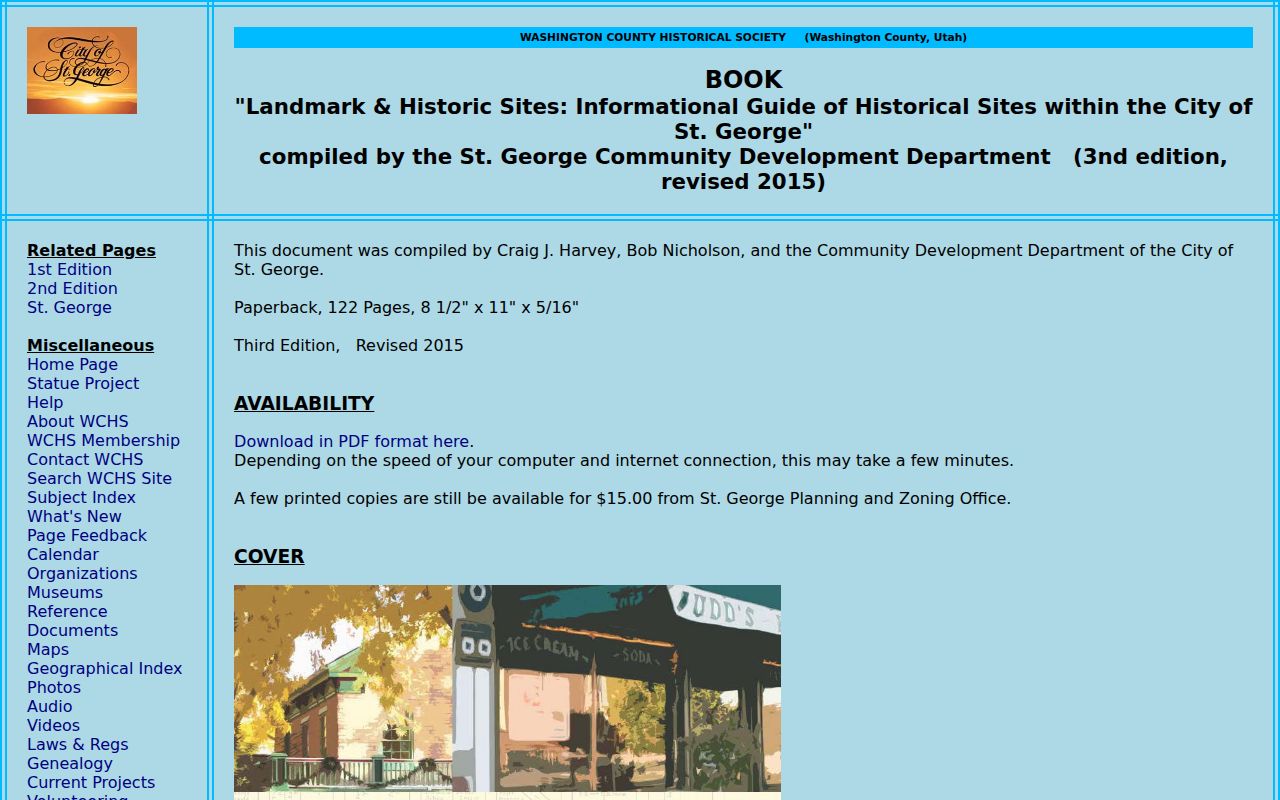
WCHS’s 2015 St. George landmarks guide can orient a property-history search. The exact St. George Sanborn sheet years were not verified, so use the Library of Congress collection as a starting point and ask an archivist for the precise sheet.
St. George Previous Resident Permits
St. George development applications can show a project or approval tied to a parcel. An inspected older building-permit record displayed a project title, permit number such as Grading-38432, drawing-of-record submission, electronic drawing, final grading report, scheduled date, and release lines for Power, Water, Wastewater, Engineering, Landscaping, and final inspection. It is an approximately 2008 sample, not a full current archive.
CityInspect is the city’s permit and inspection software route and shows login, register, and forgot-password controls. A request should state parcel or address, permit type, approximate year, project title, and whether plans, inspection history, or final approval is wanted. The city’s main contact is (435) 627-4000. A permit dates physical work; it does not identify every household member.
St. George Previous Resident Gaps
The exact Recorder online cutoff was not located. Neither a verified reverse directory shelf, dedicated obituary index, cemetery interment lookup, full Polk run, nor exact St. George Sanborn sheet-year set was found in official sources. A gap should be written down and sent to the likely custodian instead of replaced by a guess.
House-history use. Previous residents research is appropriate for genealogy, preservation, and a defined property history. Do not turn a deed, phone entry, or map clue into a current-person claim, and never use an address trail to stalk, harass, intimidate, or harm anyone.
- Chain of title
- The sequence of recorded interests linking an earlier instrument to a later one.
- Legal description
- The lot, block, survey, or metes-and-bounds wording that identifies land apart from a street address.
- Grantor
- The party shown as conveying an interest.
- Grantee
- The party shown as receiving an interest.
The best previous-residents result is a dated, layered account: title evidence from the Recorder, place evidence from maps and permits, and household clues from period sources.