
St. George City Directory Holdings
The collection table below separates a digitized local browse source from a physical regional run and from record sets that help interpret a name. A directory year is a time slice. Read its publisher, page, place, and coverage before comparing it with another year.
| Collection | Years | Where held | Access |
|---|---|---|---|
| WCHS telephone books | 1941, 1954, 1958, 1961, 1972 leads | Washington County Historical Society | Digitized browse pages and PDFs |
| Spring 1954 local book | Revised April 27, 1954 | WCHS website | St. George pages 4–33 |
| Southern Utah Phone Book, WASH-051 | 1971–2022, with stated gaps | Utah Tech Special Collections | Physical reading room or appointment |
| Washington County News | 1898–1900; restarted 1908; ceased 1988 | WCHS / Utah Digital Newspapers | Selected scans and OCR |
| Census and archives | Release and series rules apply | National Archives / Utah Archives | Online discovery, images vary |
The WCHS 1954 directory page is the best first browse point for an older St. George telephone listing.
St. George City Directory Run
Utah Tech Special Collections identifies collection WASH-051 as Southern Utah Phone Books. It includes every year from 1971 through 2022 except 1972, 1977, 1988, 1990, 2004 through 2010, and 2012. Publishers include Mountain Bell, Sun Mountain, US West, Kiwi, Phone Directories Co. (Utah’s Dixie), US West Dex, Qwest Dex, Dex, Ziplocal, The Phone Book, The Local Pages, and St. George Yellowbook.
The geographic scope is broader than incorporated St. George. Beaver, Cedar City, Enterprise, Hurricane, Kanab, and Mesquite are named alongside St. George. The six-box collection measures 7.5 linear feet. It may contain alphabetical names, phone numbers, street addresses, advertisements, maps, and service information. An application and photo ID are required, and access is free during Special Collections hours or by appointment at 330 Holland Centennial Commons, 225 South 700 East, St. George. Call (435) 634-2087 or email the repository before assuming a year is on the shelf.
The Utah Tech collection record documents the regional scope and the gaps in the long run.
WCHS St. George Directory Pages
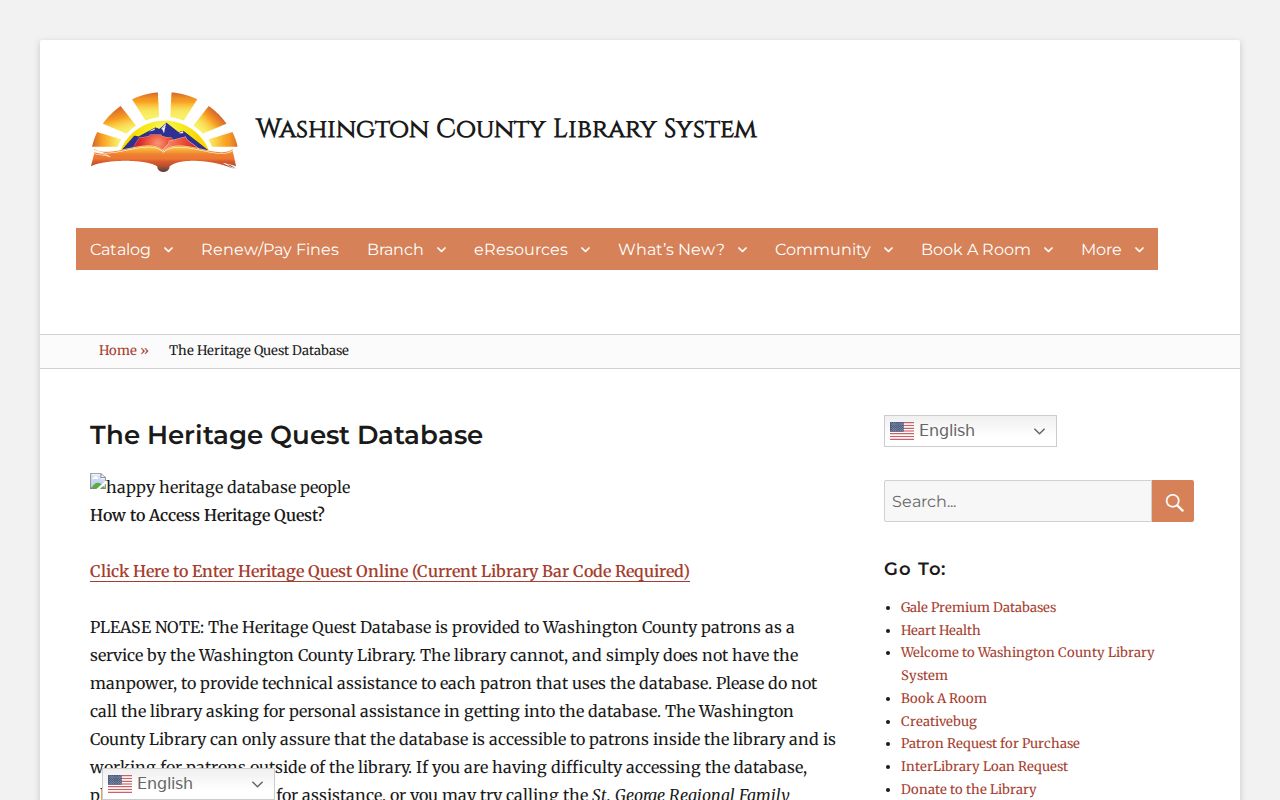
WCHS exposes Spring 1954, Fall 1958, and October 1961 telephone books as browseable pages. In 1954, St. George appears on pages 4 through 33 and Hurricane on 34 through 38. The 1958 St. George pages are 29 through 35, while the 1961 pages are 31 through 37. Those page ranges are practical shortcuts, not proof that every page is OCR-searchable.
A 1954 entry is surname-first, followed by a given name or initials, local address when printed, and a seven-digit number. Businesses may appear separately. Exchange instructions, service notices, and ads reveal the setting around a name. Save the page image or PDF link, title, publisher, revision date, and page number in the research log.
Browse the Fall 1958 WCHS book to compare its page arrangement with 1954.
Reading a St. George City Directory
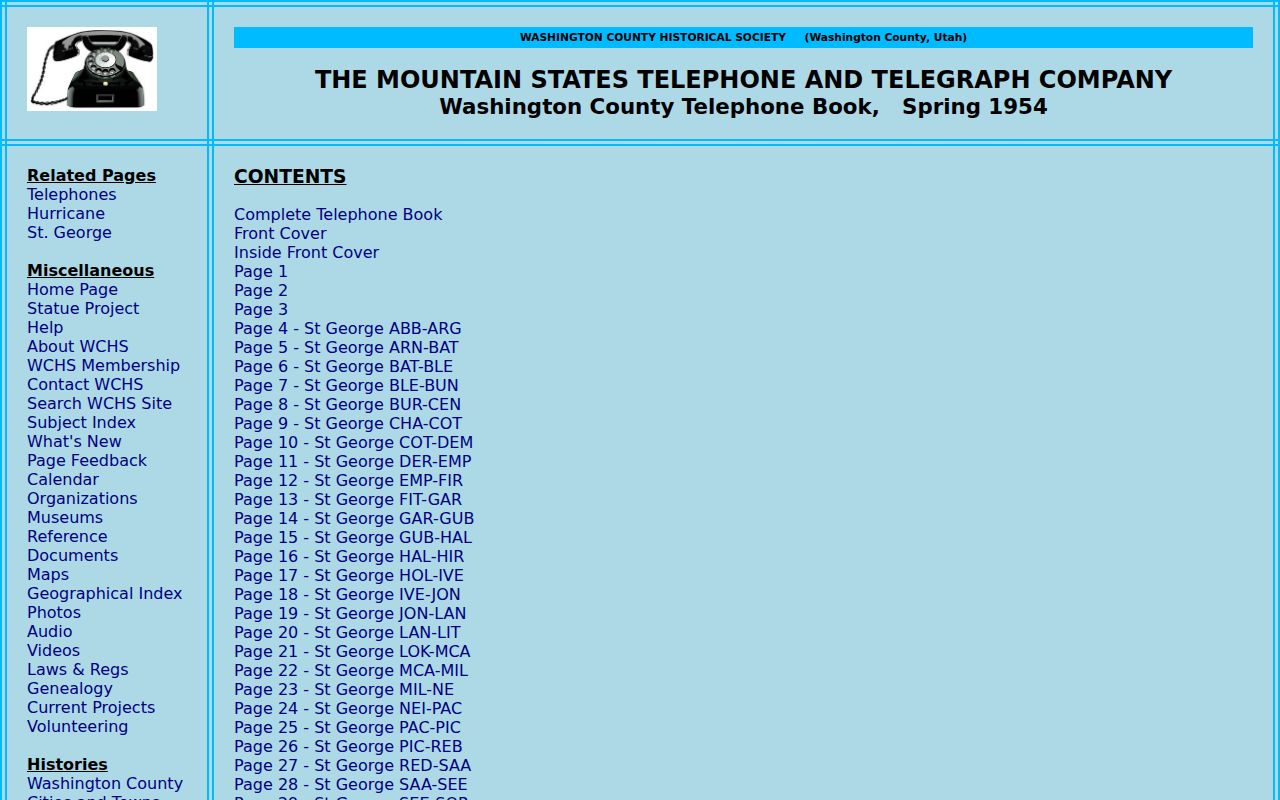
A printed entry supplies several fields, but they do not all carry equal weight. The surname and initials identify how the volume arranged the person. The number identifies a telephone connection at that moment. The street line identifies a subscriber address if one is printed. Page placement shows the source location. A business ad or emergency note gives context, not household proof.
| Entry detail | How to use it |
|---|---|
| Name order | Search surname first, preserving initials and spelling. |
| Street or local address | Compare the period wording with a plat or modern GIS. |
| Telephone number | Record the printed number and exchange, not just modern digits. |
| Page and surname range | Provides a repeatable citation in the volume. |
| Ads and service notes | Place the listing in its civic and commercial setting. |
- Householder index
- A name finding aid for a household or address; no verified St. George product was located.
- Abbreviation key
- The volume’s explanation of short forms, business marks, or phone notation.
- Criss-cross directory
- A reverse address-to-name book; the exact local shelf run remains unverified.
St. George Directory Phone Prefixes
WCHS telephone history records a local progression from ORchard 3-xxxx to 673-xxxx and then to 435. The 435 service began in September 1997 and reached Washington County by March 22, 1998. A number copied from a 1954 or 1961 page should not be searched as though it were a modern number. Retain the exchange as printed, then document the later conversion as a separate fact.
This is a useful St. George quirk. A number mismatch can reflect infrastructure, not a new person. The old office at Main and Tabernacle and the 1966 building near southeast Tabernacle and 100 East provide local context when a phone entry has no clear modern equivalent. A number still remains subscriber evidence, not a title record.
Pair Directories With Census
The National Archives’ census guidance uses a 72-year release rule. The 1950 census became public in 2022, while the 1960 census is scheduled for release in 2032. Census names, ages, relationships, and household structure can help decide whether a directory entry belongs to the family under study. The census address is another period clue, not a deed.
- Cite the directory year, page, publisher, name, number, and address exactly.
- Find the closest public census year and compare names, ages, relationships, and street wording.
- Check a period newspaper for a move, death, civic role, or business notice.
- Use a deed, plat, or modern GIS parcel to test the location.
- Keep conflicts visible; an omission or mismatch may reflect scope, timing, or a changed address.
For a modern verification, the directory trail can be handed to the St. George resident lookup process, but the historical source should remain clearly dated.
St. George Directory Newspapers
Utah Digital Newspapers provides a Washington County News example dated June 24, 1909, with a page image, OCR, publication, and archive identifier. WCHS describes the paper’s first run as June 18, 1898 through 1900, a restart on January 30, 1908, and a cessation in 1988. Another WCHS source gives a narrower digitized note for 1908 through 1923, so keep those descriptions tied to their source instead of collapsing them into one online coverage claim.
The paper’s building is another address clue. WCHS says a former Silver Reef saloon building was moved to St. George, stood at 23 East 100 North, and housed the paper until 1986. Modern references use St. George Boulevard. The exact rename year was not located. A building history can help connect a newspaper name or ad to a place without turning the address into a current person record.
Use the 1909 newspaper record for page-level OCR and image context.
St. George Directory Custodians
Washington County Library’s St. George branch is at 88 West 100 South, with posted hours Monday through Thursday 10 to 8, Friday and Saturday 10 to 6, and closure Sunday. HeritageQuest requires a current county library card and works best through the library connection. The library warns that it cannot provide technical support. Its local-information page links county, city, court, and other local routes.
WCHS’s documents page names local histories, buildings, newspapers, and WPA material. Utah State Archives provides city-and-county guides and a record-series catalog for county clerk, recorder, assessor, probate, sheriff, planning, and other groups. Those catalogs describe custody, not guaranteed online images. Ask the librarian, archivist, or society which shelf or film is actually available.
St. George Directory Gaps
The exact official Polk’s or reverse city-directory years for St. George were not located. No dedicated obituary-index page, confirmed cemetery interment search, or exact St. George Sanborn sheet-year result was verified either. These are research gaps, not invitations to fill in a likely year. Ask WCHS, Washington County Library, Utah Tech, or the State Archives whether an unindexed physical source exists.
A missing entry may mean no telephone, an unlisted number, a move, a business listing, a gap in the book, or a different geographic scope. A matching entry may still belong to another person with the same name. The sound approach is to preserve the source’s own label, pair it with census, newspaper, deed, or permit evidence, and stop at the strength of the record.
The local library’s documented path from an 1864 association, through a 1915 Carnegie grant and 1916 building, to a 1919 county transfer is a useful reminder: custody changes over time. The city directory trail may cross several institutions before it answers a family question.