
St. George Resident Lookup Questions
Before a resident lookup, write the claim you need to test. “Was this person connected to a parcel?” points to county GIS, the Assessor, and the Recorder. “Was this person registered?” points to Utah voter status. “Did this person appear in a public case?” points to Xchange. A family question may need vital records, Archives, census, or a dated directory. A professional question may need DOPL. A custody question separates the Washington County Sheriff from Utah DOC.
| Question | First source | Confirm with | Limit |
|---|---|---|---|
| Parcel association | County GIS / Assessor / Recorder | Deed, plat, mailing labels | Owner is not automatically occupant |
| Public voter registration | Utah status route | County Elections | Protected records and fields |
| Public court case | Xchange | Local clerk or document request | Billable; protected cases omitted |
| Birth, death, marriage | OVRS or SWUPHD | Relationship proof and statute | Current-copy eligibility |
| Historical name | WCHS / Utah Tech | Census, news, deed | Telephone listing is time-bound |
| License or entity | DOPL / entity search | Discipline or Recorder | Role evidence, not residence |
St. George Resident Lookup Method
Names do not carry the same role across records. A grantor conveys an interest and a grantee receives one. A plaintiff or defendant is a court party. A licensee holds a professional credential. A registered principal is linked to a business. An inmate roster entry is a custody snapshot. A telephone subscriber is a historical contact listing. Use the source’s own label beside the name.
- Preserve exact spelling, initials, suffix, alternate surname, and OCR variant.
- Add a middle initial or approximate age only when the official source accepts it.
- Compare county, court, profession, address type, date, or party role.
- Save the source URL, retrieval date, record number, and result fields.
- Stop when the source is protected or the match remains ambiguous.
An address-first search can normalize with USPS, locate a parcel in St. George or county GIS, then connect a recorded owner to a deed. A name-first search can move through voter, court, license, or historical records. Do not merge those paths without noting the change in time and purpose.
St. George Resident Court Lookup
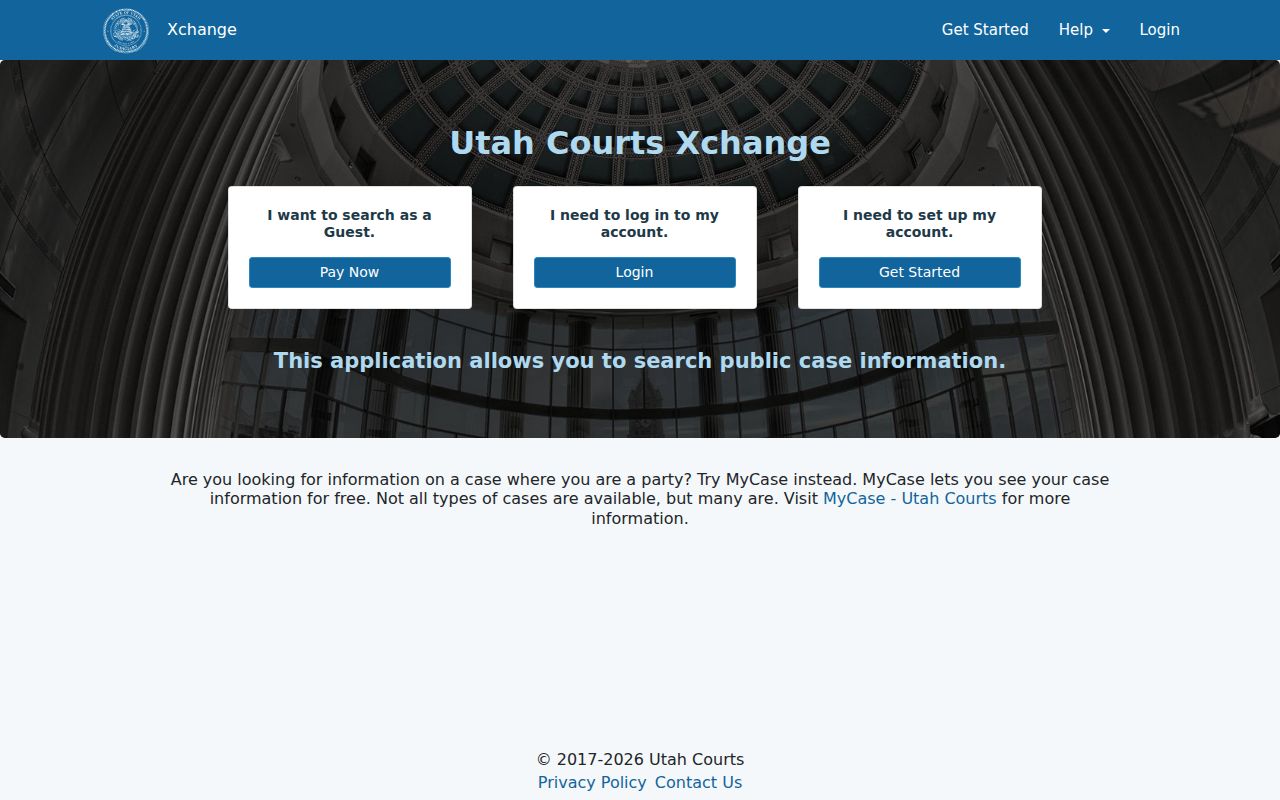
Utah Courts Xchange offers public district and justice court CORIS searches. Select Jurisdiction, then Search Type such as all cases or judgments. Enter Last Name / Company and First Name. Case Type, Search Scope, Birth Date, Citation Number, and a date range can narrow the result. Case number is the strongest anchor when known. The search is billable.
| Result field | What it tells you |
|---|---|
| County, court, case type | Where and what kind of public matter was filed. |
| Case number and filing date | Unique placement and time anchor; first two digits generally identify year. |
| Party name and code | Name plus role in the case. |
| DOB | Usually an identity aid for a criminal defendant when displayed. |
| History / Documents | Charges, plea, disposition, judge, proceedings, and public document links. |
Results cap at 500, so narrow by Washington County or Fifth District Court. Documents may cost extra. Local clerks and public courthouse terminals can supply context when the web result is incomplete.
St. George Lookup Court Limits
Xchange does not show every court matter. Sealed adoptions, civil commitments, juvenile delinquency, child-welfare and termination matters, expunged cases, and listed private civil categories are excluded. Public documents filed since July 1, 2010 are generally available electronically, but images vary. District courts have most CORIS data by the end of 1998; justice coverage varies by court.
“No result” can mean a spelling difference, a different jurisdiction, a private category, a sealed or expunged matter, or a record outside the online span. The Fifth District Court is at 206 West Tabernacle Suite 100 and can be reached at (435) 986-5700. A specific request should identify the court, case number, date, party, and desired record. Utah GRAMA or the court request form may apply, with inspection, copy, waiver, and classification choices.
The Xchange search screen shows the jurisdiction and name controls that shape a St. George resident lookup.
St. George Resident Vital Records
Utah Code §26B-8-110 makes birth records public after 100 years, death records after 50 years, and other vital records after 75 years, subject to statutory limits. Under §26B-8-125(3), a current certified birth or death copy requires a direct, tangible, and legitimate interest or a listed family, guardian, legal, or authorized basis. Identification and relationship evidence still matter.
Utah Office of Vital Records and Statistics holds death records from 1905 to the present. Southwest Utah Public Health Department’s Washington County office at 620 South 400 East, St. George, is a local route. The marriage/divorce request form lists a search plus one certified copy at $18, additional copies at $10, and optional expedited service at $15. Fees and date instructions should be checked on the current form. A vital record is event evidence, not a current resident index.
St. George Resident Voter Records
Utah’s voter status and data routes can show legal name, physical and mailing address, year or age range, party, and vote history, depending on the product and current privacy rules. Full date of birth, Social Security number, driver or state ID, email, telephone, and signature are private. Vote history indicates participation, not how a person voted. A voter address is a registration signal, not proof of ownership or a complete household list.
The April 2026 Lieutenant Governor release describes the May 25 SB153 implementation, which changed treatment of many previously private records while retaining sensitive-field protection. At-risk categories and Safe at Home protections still matter. Use the current privacy page, not an old withholding PDF alone. For a county or district file, contact Washington County Elections at (435) 301-7248 or elections@washco.utah.gov.
St. George Resident Historical Records
WCHS digitized books and Utah Tech’s Southern Utah Phone Book collection are strong historical sources for a resident lookup. Search WCHS by surname and page range. Utah Tech’s WASH-051 run covers 1971 through 2022 with gaps in 1972, 1977, 1988, 1990, 2004 through 2010, and 2012. The collection covers more than St. George. Copy the name, initials, phone, printed address, year, publisher, and page.
Pair a directory entry with a census, newspaper, deed legal description, or local history. WCHS telephone history traces ORchard 3 to 673 and then 435, so exact numeric searching can fail. A 1909 Washington County News page supplies OCR and an image, while Archives birth-register material covers 1898 through 1905. The source may prove that a name was printed, not that the person lived there throughout the year.
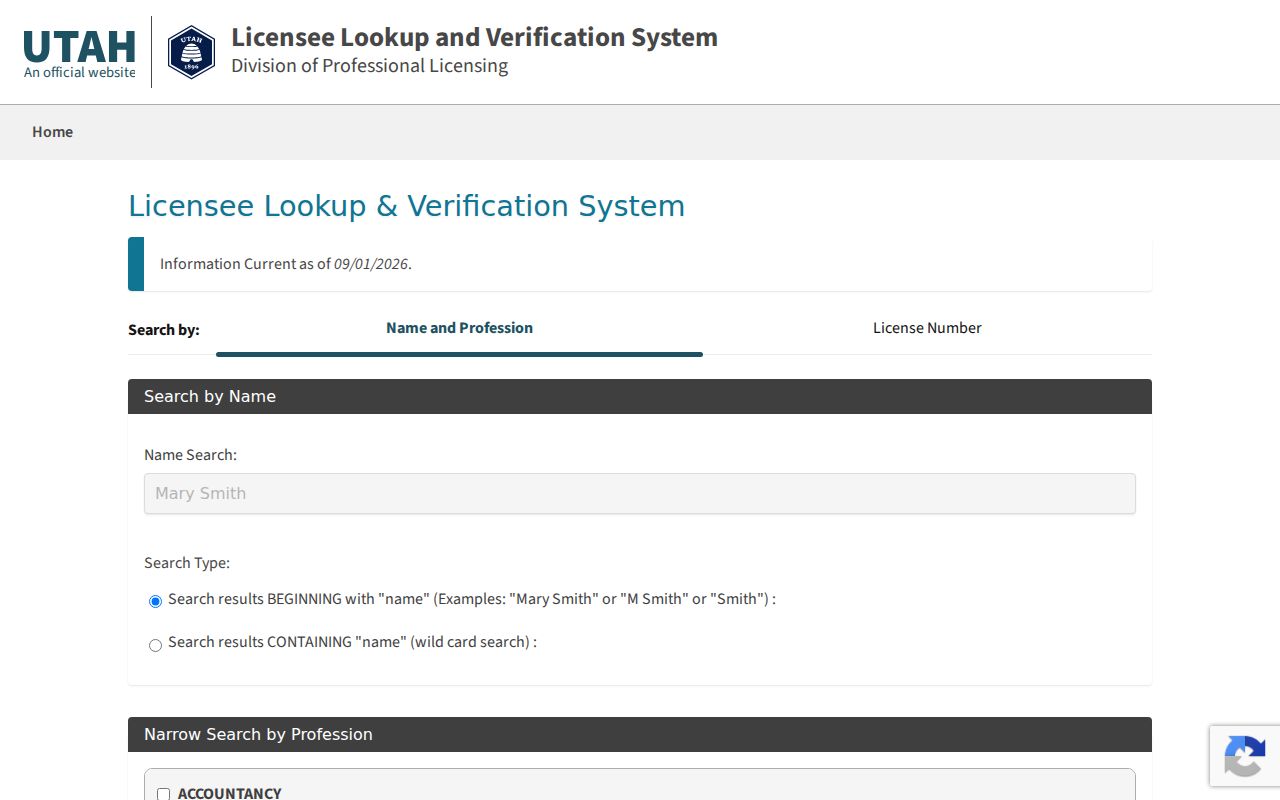
The Utah DOPL license lookup is a separate way to verify a public professional role.
St. George Resident Custody Records
Washington County Sheriff’s current roster is an alphabetical snapshot. At inspection it was dated September 1, 2026 and showed name number, name, and time incarcerated. Mugshots were removed under Utah HB228. The bookings page covers the last five days and may show name, city/state, PCF number, arrest date, agency, custody, charge, statute, court, and amounts. A booking is not a conviction.
Utah DOC’s offender search requires first and last name, with optional middle name or offender number, and covers people under UDC supervision. It does not list county pretrial or ordinary local-jail cases. VINE is a free custody notification service, not a full archive. For a specific WCSO incident, use a defined records request through the county process. Keep custody, court, and historical identity claims separate.
St. George Resident Role Records
DOPL’s public lookup can return Name, Profession, License Number, and Expiration. Its FAQ says data is updated daily at 9 PM. Discipline and citation search adds another public role record. Utah’s entity search accepts Entity Name, City, Entity Type, and County. The search hub also offers principal, trademark, and UCC routes. County assumed-name records can connect a business name to an affidavit or index.
Utah Treasurer’s MyCash accepts a last or business name and optional first name. A returned claim is only a state-treasury claim path. It is not evidence of a St. George address. Likewise, a registered principal or licensee may work in the area without living there. A good resident lookup reports the role exactly and uses a parcel, voter, court, or historical source for a different claim.
St. George Lookup Privacy Limits
Utah Safe at Home provides a substitute address for qualifying survivors of abuse, domestic violence, stalking, trafficking, or sexual assault. The actual address is concealed except for lawful court or government access. Voter withholding and at-risk rules can also remove expected fields. Never try to reconstruct a protected address from parcel, court, voter, library, or social records.
Lawful personal use. Use a resident lookup for family history, reconnecting, civic understanding, or a defined records need. Do not use an address or name trail to stalk, harass, intimidate, or harm a person.
- Docket
- The court’s record of filings, events, and case progress.
- Index
- A pointer to a record; it may not include the underlying image.
- Certified copy
- An official copy issued by the custodian, with eligibility and fees where required.
If a source is silent, say protected, unavailable, or not located. Do not replace a public-record gap with an unverified identity match.